

Gynecomastia Surgery Techniques: Liposuction vs Excision vs Combined

Written by DR DC Content Team | Medically Reviewed by Dr. Dhruv Chavan on June 26, 2026
Table Of Content
- Summary
- Three Techniques, One Decision Framework
- Liposuction: When the Cause Is Fat Only
- Excision: Removing the Glandular Disc
- The Combined Approach: The Standard for True Gynecomastia
- Technique by Grade: A Quick Reference
- What to Expect After Surgery
- As Verified By
- Frequently Asked Questions
- Book a Consultation in Pune
Gynecomastia surgery is a surgical procedure that removes excess glandular tissue, fatty tissue, or both from the male chest. Three techniques are used: liposuction, surgical excision, or a combination of both. The technique applied to any individual case depends on the composition of the tissue and the grade of the condition. This is a clinical decision made by the surgeon after a pre-operative assessment — not a patient preference.
Understanding the three techniques helps patients set accurate expectations before consultation. The approach shapes incision placement, recovery duration, and the type of scarring involved.
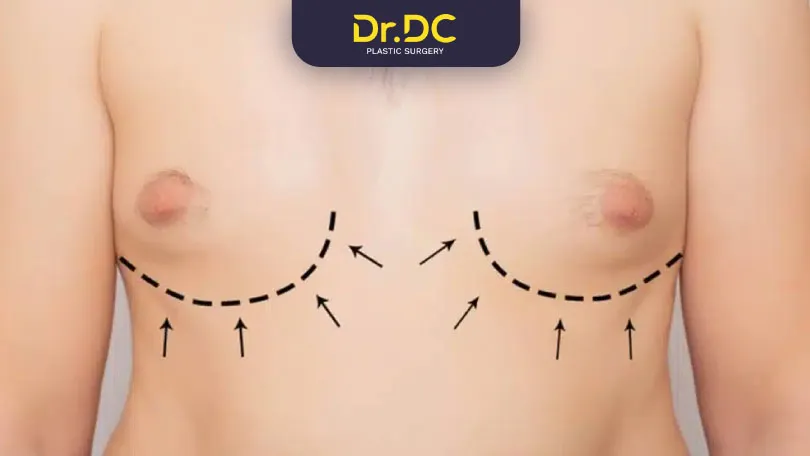
Summary
- Liposuction removes soft fatty tissue; it cannot remove a firm glandular disc.
- Gland excision surgically removes the glandular disc through an intra-areolar incision.
- Pseudogynecomastia, where chest fullness is caused by fat only, may be treated with liposuction alone.
- All true gynecomastia, Grades 1 to 4, requires liposuction combined with gland excision for a good result.
- Grades 3 and 4 with excess skin may also require skin excision alongside liposuction and gland excision.
- Technique selection is a clinical decision made by the surgeon after a pre-operative assessment.
- Dr. Dhruv Chavan performs all gynecomastia surgeries at Dr DC Plastic Surgery in Pune.
We offer a range of cosmetic treatments that help you feel confident again
Three Techniques, One Decision Framework
Gynecomastia surgery IS A surgical correction procedure that removes excess breast tissue in males by targeting the tissue type present, fatty or glandular or both. The decisive question is whether true glandular tissue is present, because that determines whether gland excision is needed.
The techniques are not interchangeable. Pseudogynecomastia, where the fullness is caused entirely by fat with no glandular disc, can be corrected with liposuction alone. True gynecomastia always contains a glandular disc, so it requires liposuction combined with gland excision regardless of grade. Liposuction alone on true glandular tissue leaves the firm disc behind and produces an incomplete result. Getting the approach right starts with an accurate clinical assessment.
Dr. Dhruv Chavan, founder and lead surgeon at Dr DC Plastic Surgery in Pune, selects the approach based on individual clinical findings at the pre-operative consultation. The decision is not finalised until after a full examination.
Liposuction: When the Cause Is Fat Only?
Liposuction works by inserting a thin cannula through a small access port, typically 2 to 4 mm, placed in a natural skin fold or at the outer edge of the areola. The cannula breaks up and suctions out soft fatty tissue. It cannot remove firm or fibrous glandular tissue.
Liposuction alone is appropriate only for pseudogynecomastia, where chest fullness is caused entirely by fat and no glandular disc is present. In true gynecomastia, a glandular disc is always present, so liposuction is used as one part of the combined procedure rather than on its own. Recovery from a liposuction-only procedure for pseudogynecomastia typically involves 3 to 5 days of rest and 4 to 6 weeks of compression garment use.
Dr. Dhruv Chavan uses power-assisted and ultrasound-assisted liposuction systems, cleared to US-FDA and CE standards. This equipment allows precise fat removal with less trauma to surrounding tissue compared to manual cannula techniques.
For a full walkthrough of what happens during the procedure, read the step-by-step gynecomastia surgery guide.
Excision: Removing the Glandular Disc
Gland excision involves surgically removing the firm glandular disc that sits behind the nipple-areola complex. The incision is placed along the lower border of the areola. Dr. Dhruv Chavan routinely uses this intra-areolar approach, which some patients informally call the “1 cm cut technique.” Incision length and placement vary based on each patient’s anatomy and clinical requirements.
Gland excision is required for all true gynecomastia, because every true case contains a glandular disc that liposuction cannot remove. This includes Grade 1 through Grade 4 cases, cases where prior liposuction left residual glandular tissue, and cases where nipple projection is caused by a firm disc that fat removal alone cannot correct.
The glandular disc is fully removed during the procedure. Partial removal increases recurrence risk and is not standard practice at Dr DC Plastic Surgery.
For patients with Grade 3 gynecomastia, where significant glandular tissue and some skin excess are both present, see Grade 3 gynecomastia treatment options in Pune for what the surgical approach involves.
The Combined Approach: The Standard for True Gynecomastia
True gynecomastia contains both a glandular disc and surrounding fatty tissue, so it is corrected with a combined approach: liposuction removes the outer fatty layer first, then gland excision removes the central glandular disc through the same or a connecting incision.
The combined approach is the standard for all true gynecomastia, Grades 1 to 4. It produces a flat, contoured chest result that liposuction alone cannot achieve when a glandular disc is present. Recovery timelines for the combined approach are 5 to 7 days of rest, 6 weeks of compression, and a phased return to physical activity.
To understand your grade before your consultation, the gynecomastia grades guide explains the Grade 1 through Grade 4 classification with symptoms and typical surgical implications.
Technique by Grade: A Quick Reference
The relationship between the presentation and the surgical approach is direct and consistent:
- Pseudogynecomastia (chest fullness from fat only, no glandular disc): Liposuction alone.
- Grade 1 true gynecomastia (minor enlargement, no skin excess): Liposuction with gland excision.
- Grade 2 (moderate enlargement, no excess skin): Liposuction with gland excision.
- Grade 3 (significant enlargement, minor skin excess): Liposuction with gland excision, and may require skin excision.
- Grade 4 (large enlargement, significant skin excess): Liposuction with gland excision and skin excision.
Grade 4 cases require the most surgical planning. Significant skin ptosis means skin must be removed alongside the glandular tissue and fat, which involves additional incision design by Dr. Dhruv Chavan before the procedure date.
For candidacy criteria across all grades, see Am I a Good Candidate for Gynecomastia Surgery?
What to Expect After Surgery?
Regardless of the approach, gynecomastia patients at Dr DC Plastic Surgery follow the same core recovery framework: compression garment worn for 6 weeks, light activity from Week 2, gym and heavy lifting from Week 6 to 8. Rest duration is slightly shorter for pseudogynecomastia treated with liposuction alone (3 to 5 days, versus 5 to 7 days for procedures that involve gland excision).
Final results, including full chest contour definition, are typically visible at 3 to 6 months once post-operative swelling fully resolves. For a full breakdown of timelines, see the gynecomastia surgery recovery guide.
Before-and-after results from Dr. Dhruv Chavan’s patients are available in the gynecomastia results gallery.
As Verified By
The technique classification and grade-to-approach relationships in this article align with the following published sources:
-
- American Society of Plastic Surgeons. Gynecomastia: Practice Guidelines. plasticsurgery.org
- Rohrich RJ et al. Classification and Management of Gynecomastia. Plastic and Reconstructive Surgery. pubmed.ncbi.nlm.nih.gov
- Handschin AE et al. Surgical Management of Gynecomastia. British Journal of Surgery. pubmed.ncbi.nlm.nih.gov
- Cleveland Clinic. Gynecomastia (Male Breast Enlargement). my.clevelandclinic.org
- Simon BE et al. Classification and Surgical Correction of Gynecomastia. Plastic and Reconstructive Surgery. pubmed.ncbi.nlm.nih.gov
We Offer Range Of Cosmetic Treatments Which helps be confident again
Frequently Asked Questions
Is liposuction or excision better for gynecomastia?
They are not competing alternatives. For true gynecomastia, both are used together, because liposuction removes the fatty layer and gland excision removes the firm disc that liposuction cannot. The combined approach is the standard for all grades of true gynecomastia.
Liposuction alone is appropriate only for pseudogynecomastia, where the fullness is caused by fat and no glandular disc is present. Dr. Dhruv Chavan determines the appropriate approach after a clinical assessment at consultation.
Will I have visible scars after gynecomastia surgery?
All surgical approaches leave some mark, but incision placement is designed to minimise visibility. Liposuction access ports are 2 to 4 mm and placed in natural skin folds. Gland excision incisions are placed along the lower border of the areola, where the colour transition naturally conceals the line.
Final scar appearance varies based on individual anatomy, skin type, and healing response. Dr. Dhruv Chavan discusses incision placement in detail at the pre-operative consultation.
Can gynecomastia be treated with liposuction alone?
Liposuction alone is appropriate only for pseudogynecomastia, where the fullness is caused entirely by fatty tissue and no glandular disc is present. It is not sufficient for true gynecomastia, because a cannula cannot remove the firm glandular disc.
Treating true gynecomastia with liposuction alone leaves the disc in place and typically produces a visible residual mound. This is why all true gynecomastia, Grades 1 to 4, requires liposuction combined with gland excision. Clinical assessment before surgery confirms which applies to your case.
What technique is used for Grade 3 or Grade 4 gynecomastia?
Grade 3 and Grade 4 cases both require liposuction combined with gland excision, because true glandular tissue is present at every grade. Grade 3 cases with minor skin excess may also require skin excision, and Grade 4 cases with significant skin excess always require skin excision alongside the liposuction and gland excision.
The exact plan is determined by individual clinical findings. Grade 4 needs the most planning because excess skin must be removed and the incision design is tailored before the procedure date.
How long does it take to see results after gynecomastia surgery?
Initial results, including a noticeably flatter chest, are visible within 2 to 4 weeks once major swelling reduces. Final results with full contour definition are typically visible at 3 to 6 months. This timeline applies across all approaches.
Compression garments, worn for 6 weeks post-surgery, support tissue settling and help the chest reach its final contour faster. Full physical activity, including gym training, is typically cleared from Week 6 to 8 depending on recovery progress.
Book a Consultation in Pune
If you want to know which approach applies to your case, the next step is a clinical assessment.
Dr. Dhruv Chavan offers consultations at 6 locations across Pune, including Pimple Saudagar, Kharadi, Baner, NIBM, Prabhat Road, and Sasoon Road. Both in-person and online consultations are ₹1,000. Follow-up consultation is ₹700.
Book a gynecomastia consultation at Dr DC Plastic Surgery
For a full overview of the procedure, candidacy criteria, costs, and recovery, visit the gynecomastia surgery page at drdc.co.
Reviewed by Dr. Dhruv Chavan, MCh (Plastic & Cosmetic Surgery), Fellowship in Aesthetic Surgery. Founder and lead surgeon, Dr DC Plastic Surgery, Pune. Medical Council No. 2016/06/1369.
Surgical outcomes vary by individual. Nothing in this article constitutes a guarantee of results. Technique selection is made at the surgeon’s clinical discretion following pre-operative consultation.

Dr Dhruv Chavan, MBBS, MCh

Further Reading

Gynecomastia Surgeon in Pune: What to Look For (and Ask)?
Looking for a gynecomastia surgeon in Pune? Learn how to check qualifications, experience, surgical techniques, safety standards, and patient reviews.
Gynecomastia Surgery Scarring: What to Expect and How to Minimise It?
Learn what gynecomastia surgery scars look like, how long they take to fade, and how silicone gel and proper aftercare help minimise scarring.

Blepharoplasty Risks and Complications in Pune: What to Know Before Surgery
Blepharoplasty risks in Pune: dry eye, lagophthalmos, haematoma, ectropion, and scleral show explained by MCh plastic surgeon Dr. Dhruv Chavan. What is normal and what needs attention.
OUR PROCESS
360 Holistic Approach
We take care of everything; before, during, and after your procedure. From consultations to recovery, we focus on precision and care. Result? We deliver a wonderful experience and the best results.

Thorough Evaluation & Consultation

Realistic Goal Setting

Procedure
Planning

Post-Op
Care
We listen, assess, and plan every step to match your goals. Advanced techniques deliver natural results, while dedicated post-op care supports healing and long-term success. Your safety, comfort, and confidence guide every decision, so you always feel informed, supported, and in expert hands.