

Gynecomastia Surgery Scarring: What to Expect and How to Minimise It?

Written by DR DC Content Team | Medically Reviewed by Dr. Dhruv Chavan on October 21, 2026
Table Of Content
- Key Takeaways
- What Does the Scar Look Like After Gynecomastia Surgery?
- Why the Intra-Areolar Cut Minimises Scarring?
- The Scar Healing Timeline
- How to Minimise Your Gynecomastia Scar?
- Scar-Care Products: What the Evidence Supports?
- When Should You Be Concerned About a Scar?
- Does Scarring Change with the Grade of Gynecomastia?
- As Verified By
- Frequently Asked Questions
- Plan Your Gynecomastia Consultation in Pune
Gynecomastia surgery scarring is minimal because the gland is removed through a small cut placed within the areola, where the scar is difficult to see once healed. At Dr DC Plastic Surgery in Pune, Dr. Dhruv Chavan uses a 1-cm intra-areolar cut that sits inside the natural pigmented edge of the areola. Across published studies, the large majority of patients rate their scar quality as excellent.
This article explains what the scar looks like, how it heals over time, and the aftercare steps that keep it as faint as possible. Scar appearance varies between individuals, so the guidance here describes typical healing rather than a guaranteed result.
Key Takeaways
- The gland is removed through a 1-cm cut placed within the areola, so the scar is well hidden.
- In published research, over 97 percent of patients rate their scar quality as excellent.
- Scars fade significantly over 6 to 12 months and are reviewed at the later follow-up.
- Silicone gel is the evidence-based gold standard for improving scar appearance.
- Starting scar care within the first two weeks gives the best results.
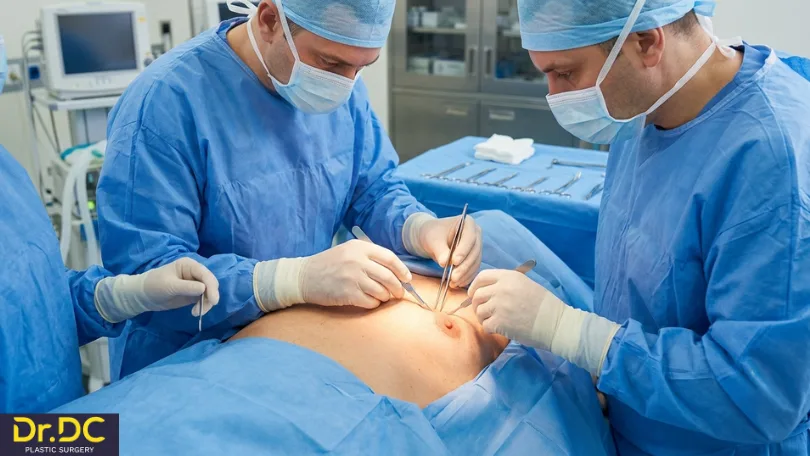
We offer a range of cosmetic treatments that help you feel confident again
What Does the Scar Look Like After Gynecomastia Surgery?
The scar from gynecomastia surgery at Dr DC is small and positioned inside the areola, where the change in skin colour helps conceal it. For grade1 to grade 4, this is a single cut of 1 cm.
In the early weeks the scar looks pink or slightly raised, which is a normal part of healing. Over the following months it flattens and fades to a fine line that blends into the pigmented edge of the areola. Because the cut is small and hidden, most patients find the scar difficult to see once healed, especially compared with the visible chest contour they came in with. The gynecomastia results page shows typical outcomes.
Scar visibility matters most to men with very low body fat, such as bodybuilders, because there is little surrounding tissue to soften the appearance of any mark. For this group, the intra-areolar position of the cut is a particular advantage, since it keeps the scar inside the areola rather than on the exposed chest. The guidance for bodybuilders covers this in more detail. For most patients, the small, hidden scar is a fair trade for removing a chest contour they have wanted gone for years.
We Offer Range Of Cosmetic Treatments Which helps be confident again
Why the Intra-Areolar Cut Minimises Scarring?
The position and size of the cut are the biggest factors in how visible your scar will be. Dr. Dhruv Chavan places a 1-cm cut within the areola, not at its border, so the scar sits inside the naturally pigmented skin where it is hardest to see.
This intra-areolar approach is a well-established scar-minimising technique in gynecomastia surgery. Combining it with power-assisted and ultrasound-assisted liposuction means the fatty component is treated through the same small access point, avoiding the longer incisions that older techniques required. A small, clean cut also heals more predictably, which is supported by the Dr DC infection rate under 1 percent. The step-by-step surgery guide explains how the cut is used during the procedure.
Scar Healing at a Glance
| Stage | What to Expect? |
|---|---|
| First 2 weeks | Cut closed, mild redness, begin scar care as advised |
| Weeks 3 to 6 | Scar may look pink or slightly raised, this is normal |
| Month 2 to 3 | Redness fades, scar begins to flatten |
| Month 6 | Scar reviewed at follow-up, significantly faded |
| Month 6 to 12 | Scar matures to a fine, pale line within the areola |
The Scar Healing Timeline
A surgical scar does not reach its final appearance straight away. It matures over several months, and understanding this timeline prevents unnecessary worry during the early weeks.
For the first two to six weeks, the scar is often pink or slightly firm, which is the body actively healing. Over months two and three, the redness settles and the scar begins to flatten. By the six-month follow-up, Dr. Dhruv Chavan reviews the scar once it has substantially faded, and it continues to lighten toward its final appearance up to twelve months. Judging the scar in the first few weeks gives a misleading picture, because it looks its most obvious before it settles.
To recap the scar picture so far: gynecomastia surgery at Dr DC uses a 1-cm cut within the areola, so the scar is small and well hidden, and it fades over 6 to 12 months to a fine pale line. The two things that most affect your final scar are the technique used and how well you follow scar care. The sections below cover exactly how to minimise your scar and how grade changes what to expect.
How to Minimise Your Gynecomastia Scar?
Your aftercare has a real, measurable effect on how your scar turns out. A few evidence-based steps give the best chance of a faint, flat scar.
Silicone gel is the gold-standard scar treatment, with research showing improvement in scar appearance when it is applied correctly and started early. Beginning silicone-based scar care within the first two weeks of healing produces measurably better results than starting late. Gentle massage once the cut has healed helps soften and flatten the scar, and protecting the area from direct sun prevents the scar from darkening. Not smoking is also important, because smoking impairs healing and worsens scars.
Consistency is what makes these steps work. Silicone gel needs to be applied daily over several weeks to have its full effect, and stopping early is a common reason scars do not fade as well as they could. Keeping the compression garment on as advised also supports the healing skin during the first weeks, when the scar is forming. Dr. Dhruv Chavan provides a scar-care plan as part of the recovery guidance, and reviews progress at each follow-up so the plan can be adjusted if needed.
Scar-Care Products: What the Evidence Supports
Not every scar product works, so it helps to know what the research actually backs. Focusing on evidence-based options avoids wasting money on treatments that do little.
Silicone gel and silicone sheets are the best-supported option, working by keeping the healing skin hydrated so the scar flattens and fades. This is why silicone is considered the gold standard in scar care after surgery. Gentle massage of the healed scar also helps soften it. Products like vitamin E oil are popular but have weaker evidence, so they are best seen as optional rather than essential. Whatever you use, consistency and an early start matter more than the specific brand. Dr. Dhruv Chavan advises which products to use and when to begin at your follow-up, as part of the gynecomastia surgery aftercare plan.
When Should You Be Concerned About a Scar?
Most gynecomastia scars heal well, but a small number of people are prone to thicker scars, and knowing the signs means you can act early. Raised, thickened, or spreading scars are worth reviewing with your surgeon.
Some individuals develop hypertrophic or keloid scars, where the scar becomes raised and firm rather than flattening over time. This is more common in those with a personal or family history of keloids, which is why Dr. Dhruv Chavan asks about this at the consultation. If a scar becomes increasingly raised, itchy, or darker over the first few months, it should be reviewed so treatment can start early. Early management of a problem scar produces a much better result than waiting, and this is one reason the scheduled follow-up visits matter.
Does Scarring Change with the Grade of Gynecomastia?
Yes, the amount of scarring depends on the grade of your case. Lower-grade cases have the smallest, best-hidden scars, while severe cases require longer incisions.
Grade 1 and Grade 2 cases are usually treated through the single 1-cm intra-areolar cut, giving the most discreet scar. Grade 3 and especially Grade 4 cases involve more tissue and loose skin, so skin excision and longer incisions may be needed, which produces a more visible scar.
This trade-off is a necessary part of correcting severe gynecomastia, and Dr. Dhruv Chavan places any longer incisions along natural skin lines to limit visibility. The guide to gynecomastia grades explains how grade is assessed, and the Grade 4 surgery page covers the approach for the most severe cases.
As Verified By
The scarring information in this article is consistent with published surgical literature:
- A comprehensive review of techniques to minimise scars in the surgical management of gynecomastia (PMC) evaluates incision approaches and scar outcomes.
- A large multicentric study of ultrasound and power-assisted devices for gynecomastia (PMC) reports on scar and contour outcomes with combined techniques.
- A study on patient-reported satisfaction after ultrasound-assisted liposuction with infra-areolar excision (PMC) documents high scar-quality ratings.
- A study on single axillary incision endoscopic surgery for gynecomastia (PMC) describes scar-minimising surgical approaches.
- Gynecomastia, StatPearls (NCBI Bookshelf) provides clinical background on surgical management.
Frequently Asked Questions
Will gynecomastia surgery leave a visible scar?
Scarring is minimal because the gland is removed through a 1-cm cut placed within the areola, where the scar is difficult to see once healed. Across published studies, over 97 percent of patients rate their scar quality as excellent.
Scar appearance varies between individuals and a faint mark at close range is normal. The scar fades over 6 to 12 months and is reviewed at the six-month follow-up.
Where is the scar located after gynecomastia surgery?
The scar is located within the areola, inside its naturally pigmented edge, because Dr. Dhruv Chavan places the cut there rather than at the border. This position makes the scar much harder to see once healed.
For Grade 1 and Grade 2 cases this is usually a single small cut. Higher-grade cases may need longer incisions, which are placed along natural skin lines to limit visibility.
How can I make my gynecomastia scar fade faster?
Silicone gel is the evidence-based gold standard and works best when started within the first two weeks of healing. Gentle massage after the cut has healed, sun protection, and not smoking all help the scar fade.
Dr. Dhruv Chavan provides a scar-care plan after surgery. Following it closely gives the best chance of a faint, flat scar.
How long does it take for a gynecomastia scar to fade?
A gynecomastia scar fades significantly over 6 to 12 months. It often looks pink or slightly raised in the first few weeks, then flattens and lightens over the following months.
Dr. Dhruv Chavan reviews the scar at the six-month follow-up once it has substantially faded. Judging the scar too early gives a misleading picture because it looks most obvious before it settles.
Do higher grades of gynecomastia leave bigger scars?
Yes, higher grades leave more visible scars. Grade 1 and Grade 2 cases use a single 1-cm intra-areolar cut, giving the most discreet scar, while Grade 3 and Grade 4 cases may need skin excision and longer incisions.
Any longer incisions are placed along natural skin lines to limit visibility. The trade-off is necessary to correct the loose skin and larger tissue volume in severe cases.
We Offer Range Of Cosmetic Treatments Which helps be confident again
Plan Your Gynecomastia Consultation in Pune
If scarring is a concern, an in-person assessment with Dr. Dhruv Chavan explains exactly what to expect for your grade and how the cut is placed. In-person consultations are free at all six Dr DC locations across Pune. To book, contact Dr DC Plastic Surgery.

Dr Dhruv Chavan, MBBS, MCh

Further Reading
Blepharoplasty Risks and Complications in Pune: What to Know Before Surgery
Blepharoplasty risks in Pune: dry eye, lagophthalmos, haematoma, ectropion, and scleral show explained by MCh plastic surgeon Dr. Dhruv Chavan. What is normal and what needs attention.
Non-Surgical Rhinoplasty (Nose Filler) in Pune
Nose filler in Pune: understand benefits, limitations, risks, cost and results. Dr. Dhruv Chavan explains when filler or surgical rhinoplasty may suit you.
Burn Scar Treatment in Pune: Options, Outcomes, and What to Expect
Burn scar treatment in Pune, including laser, compression therapy, skin grafting and contracture release. Reviewed by Dr. Dhruv Chavan.
OUR PROCESS
360 Holistic Approach
We take care of everything; before, during, and after your procedure. From consultations to recovery, we focus on precision and care. Result? We deliver a wonderful experience and the best results.

Thorough Evaluation & Consultation

Realistic Goal Setting

Procedure
Planning

Post-Op
Care
We listen, assess, and plan every step to match your goals. Advanced techniques deliver natural results, while dedicated post-op care supports healing and long-term success. Your safety, comfort, and confidence guide every decision, so you always feel informed, supported, and in expert hands.