

Burn Scar Treatment in Pune: Options, Outcomes, and What to Expect?

Written by DR DC Content Team | Medically Reviewed by Dr. Dhruv Chavan on October 17, 2026
Table Of Content
- Types of Burn Scars and What Drives the Treatment Decision
- The Timing of Burn Scar Treatment
- Non-Surgical Burn Scar Management
- Surgical Options for Burn Scar Treatment in Pune
- Who May Be a Candidate for Burn Scar Surgery
- Who May Not Be a Suitable Candidate or Should Wait
- Risks of Burn Scar Surgery
- Post-Operative Care and Scar Management After Burn Scar Surgery
- Urgent-Care Guidance After Burn Scar Surgery
- Cost of Burn Scar Treatment in Pune
- Frequently Asked Questions
Burn scars present differently from other types of scarring, and their treatment is more complex. The nature of the original burn injury, the depth of tissue damage, the body area affected, and the time that has passed since the burn all influence what treatment options are appropriate and what results are achievable. Burn scar management in Pune ranges from conservative non-surgical methods for recently healed burns to reconstructive surgery for longstanding contractures affecting movement and function. This guide explains the types of burn scars seen in clinical practice in Pune, what each requires, and how a plastic surgeon approaches treatment planning.
Burn scar treatment in Pune depends on the scar type: hypertrophic and raised burn scars are managed with compression therapy, silicone, steroid injection, and laser; contractures restricting movement require surgical release and skin grafting or flap reconstruction; pigmentation changes are addressed with laser and topical management. Dr. Dhruv Chavan at Dr. DC Plastic Surgery, Pune, is an MCh Plastic Surgery qualified plastic surgeon and APSI member assessing and treating burn scars at six Pune clinic locations.
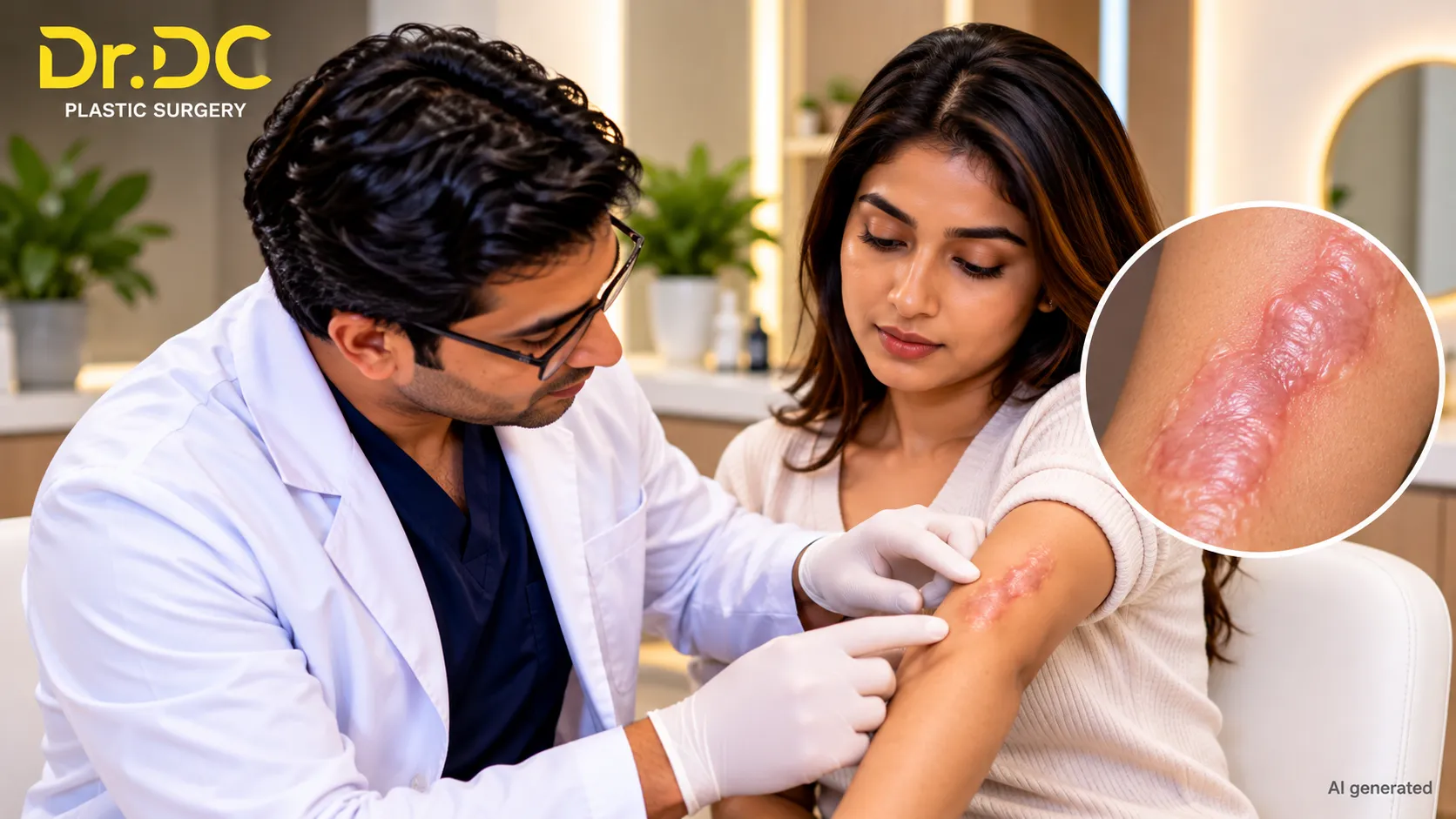
Types of Burn Scars and What Drives the Treatment Decision
Burn injuries damage skin and underlying tissue at varying depths. The depth of the original injury determines what the skin can regenerate and what the long-term scar will look like. The scar types that present for treatment in Pune:
-
- Hypertrophic burn scars: Raised, firm, red or pink scars that remain within the boundaries of the original burn area. These are the most common burn scar type following deep partial-thickness and full-thickness burns. They cause itching, tightness, and discomfort, and in functionally important areas (around joints, on the face, over the neck) they can restrict movement as the scar tissue contracts. They respond to a combination of compression therapy, silicone, steroid injection, and laser. For more on hypertrophic scar management, see the hypertrophic scar treatment guide.
- Burn scar contractures: When a burn heals across a joint or over a surface that requires mobility (the neck, the axilla, the elbow, the hand, the face), the shortening of the scar tissue as it matures pulls the surrounding structures toward each other. This is a contracture. It restricts movement mechanically: a neck burn contracture limits the ability to look up; an axillary contracture limits arm elevation; a hand contracture limits grip and finger extension. Contractures are the primary functional indication for surgery in burn scar patients. They require surgical release and replacement of the contracted tissue with skin grafting or local and regional flaps.
- Burn keloid scars: Raised scars that extend beyond the original burn boundaries. Less common than hypertrophic burn scars but more difficult to treat. Management follows the keloid protocol: steroid injection, surgical excision where appropriate, and post-operative steroid and pressure management to prevent recurrence. For keloid-specific management, see the keloid treatment guide.
- Hypopigmented burn scars: Pale or white areas where melanocytes (pigment-producing cells) were destroyed by the burn. The skin has healed but does not produce normal pigmentation. Surgical options include melanocyte transplantation or grafting from pigmented skin; laser and camouflage tattooing are additional options. Results vary depending on the extent of pigment loss and the patient’s baseline skin tone.
- Hyperpigmented burn scars: Darkening of healed burn areas, particularly in patients with darker skin tones, including many Indian patients. Post-inflammatory hyperpigmentation following burns can be addressed with laser treatment and topical depigmenting agents. Sun protection is critical, as UV exposure worsens pigmentation in healing burn skin.
- Atrophic burn scars: Depressed, thin-skinned areas where the burn damaged the dermis significantly. These areas are fragile and prone to recurrent ulceration. Management may involve skin grafting to replace the thin scar with more durable tissue, or laser to stimulate dermal thickening and improve skin quality.
The Timing of Burn Scar Treatment
The timing of intervention is important in burn scar management and is often misunderstood by patients who present in the weeks after a burn has healed.
Active burn scar maturation continues for 12 to 24 months after the wound has healed. During this period, the scar is still changing: it may still be softening, fading, and improving. Non-surgical methods applied during this phase, primarily compression garments, silicone sheets or gel, and steroid injection for particularly raised or symptomatic scars, can significantly modify the final outcome. Starting these early, in the active maturation phase, produces better results than waiting until the scar has fully matured.
Surgical intervention for burn scars is generally planned after the scar has stabilised and matured, typically at 12 months or beyond, unless there is a functional indication (such as a contracture preventing movement) that requires earlier release. Operating on an immature burn scar increases the risk of recurrent hypertrophic healing around the new surgical wounds.
“I see patients in Pune who come to me six weeks after a burn has healed and want it surgically treated immediately,” says Dr. Dhruv Chavan, plastic surgeon at Dr. DC Plastic Surgery, Pune. “In most of those cases, the most important thing I can do at that consultation is start them on a structured non-surgical programme: compression therapy, silicone, steroid injection where the scar is raised and symptomatic. A year of good conservative management changes what the scar looks like significantly, and sometimes it removes the need for surgery altogether. The surgery, if we eventually need it, works better on a mature scar than a fresh one.”
Non-Surgical Burn Scar Management
Non-surgical management is the standard of care for burn scars during the maturation phase and remains relevant even after maturation for patients who are not surgical candidates or who achieve satisfactory results without surgery.
Compression therapy: Custom-fitted pressure garments worn over the burn scar area for 23 hours a day reduce the height of hypertrophic burn scars and accelerate maturation. They work by applying constant pressure that limits the blood supply to the excess scar tissue and reduces collagen overproduction. Garments are worn for 12 to 24 months in significant hypertrophic burn scarring.
Silicone therapy: Silicone sheets or gel applied over healed burn scars reduce their height, firmness, and redness. The mechanism is similar to compression: creating an occlusive microenvironment that modifies collagen formation. Silicone is used alongside compression garments where practical, and independently where garments are not appropriate for the anatomy.
Intralesional steroid injection: Triamcinolone acetonide injected directly into raised, symptomatic burn scars reduces scar firmness and height, relieves itching, and softens the scar tissue. A series of injections spaced 4 to 6 weeks apart is typical. Steroid injection is particularly useful for localised areas of significant hypertrophic scarring.
Laser treatment: Vascular laser (for redness and vascularity) and fractional laser (for texture, thickness, and surface quality) are used for burn scars during and after the maturation phase. Laser does not replace compression or silicone in the active maturation phase but complements them and is more appropriate as a stand-alone treatment after maturation for texture and pigmentation concerns.
Surgical Options for Burn Scar Treatment in Pune
Surgery is considered for burn scars that have functional implications (contractures restricting movement), for cosmetically significant mature scars that have not responded adequately to non-surgical management, or for areas where skin quality is too poor to heal normally (atrophic or fragile areas prone to ulceration).
Contracture release and skin grafting: The contracted scar tissue is divided or excised, releasing the tension on the joint or surface below. The resulting wound is too large to close directly and requires skin coverage. Split-thickness skin grafting (thin sheets of skin harvested from a donor site elsewhere on the body and placed over the wound) is the most common coverage method. Full-thickness skin grafting (including the deeper dermis) provides better quality coverage for visible or functional areas such as the face and hands but requires a donor site that is closed directly.
Z-plasty and local flap reconstruction: For linear contractures (particularly in the neck and joints), Z-plasty rearranges local skin flaps to break up the line of the contracture and gain length. Multiple Z-plasties may be combined along the length of the contracture. Where local tissue quality is sufficient, local or regional flaps provide more durable coverage than skin grafts for functionally demanding areas.
Tissue expansion: In areas where significant scarring needs to be replaced with normal skin, tissue expanders placed beneath adjacent unburned skin are gradually inflated over several weeks to months, stretching the skin to create a surplus. This expanded skin is then used to cover the area from which the scar has been excised. Tissue expansion is a staged procedure requiring patience but produces coverage with skin that matches the surrounding area in colour and texture better than distant grafts.
“For a significant contracture of the neck or the axilla, the principle is always the same: release the contracture completely to restore the full range of movement, and then cover the defect with the most appropriate tissue available,” says Dr. Dhruv Chavan, plastic and reconstructive surgeon at Dr. DC Plastic Surgery, Pune. “Whether that is a split-thickness graft, a full-thickness graft, a local flap, or a combination depends on the site, the defect size, the patient’s donor site availability, and the functional demands of the area. The planning is specific to each patient.”
Do You Need a Doctor Consultation
Who May Be a Candidate for Burn Scar Surgery?
A consultation with an MCh Plastic Surgery qualified surgeon determines candidacy and the appropriate procedure. General factors supporting surgical candidacy include: mature burn scar (typically 12 or more months post-healing, unless functional contracture requires earlier release), adequate general health for surgery and anaesthesia, a clear functional or cosmetic indication for surgery, realistic expectations about achievable results, and adequate donor sites for grafting where skin grafting is planned. For more on what scar revision surgery involves, see the scar revision surgery .
Who May Not Be a Suitable Candidate or Should Wait?
Patients whose burn scars are still maturing (less than 12 months post-healing, with no pressing functional indication) benefit from non-surgical management before surgical decisions are made. Active smokers have impaired healing and increased graft failure risk. Patients with systemic conditions affecting wound healing require optimisation before surgery. Patients with unrealistic expectations about the degree of cosmetic improvement possible are better served by further consultation to calibrate expectations before proceeding to surgery.
Risks of Burn Scar Surgery
Surgical treatment of burn scars carries risks discussed at consultation. Risks of skin grafting include: graft failure (where the graft does not take and the wound requires regrafting), infection, donor site scarring, colour mismatch between graft and surrounding skin, contracture recurrence at the release site, and need for additional procedures. Risks of Z-plasty and local flaps include: flap necrosis, wound dehiscence, and visible scarring at the donor site. General risks of surgery under anaesthesia apply to all procedures: infection, bleeding, adverse anaesthetic reaction. Results depend on individual healing, skin type, and extent of original burn injury. No specific cosmetic result can be guaranteed.
Post-Operative Care and Scar Management After Burn Scar Surgery
Burn scar surgery does not end the need for scar management. The new surgical wounds and skin grafts require the same structured aftercare as any scar: compression (often resumed over grafted areas), silicone therapy once wounds are healed, and sun protection to prevent pigmentation in the healed grafts. This is discussed in detail at the pre-operative consultation and at discharge. For a full overview of scar revision aftercare, see the scar revision aftercare guide.
Urgent-Care Guidance After Burn Scar Surgery
Contact the clinic or an emergency service immediately if you experience any of the following after burn scar surgery: fever above 38 degrees Celsius, spreading redness or warmth beyond the wound edges, heavy bleeding that does not settle with gentle pressure, severe or rapidly increasing swelling, wound dehiscence (wound edges separating), skin graft that appears black or non-viable, or any chest pain or breathing difficulty. These symptoms require immediate clinical assessment and should not be managed at home without guidance.
Book a Burn Scar Assessment in Pune
Dr. Dhruv Chavan, MCh Plastic Surgery, APSI member, assesses each burn scar patient’s scar type, maturation stage, functional impact, and appropriate management pathway at consultation, with a clear explanation of what surgical and non-surgical options can achieve.
Call +91 99604 341 11 | Scar Revision at Dr. DC Plastic Surgery
We offer a range of cosmetic treatments that help you feel confident again
Cost of Burn Scar Treatment in Pune
|
Treatment |
Approximate Cost |
|
Steroid injection for burn scar (per session) |
Rs. 3,000 to Rs. 8,000 |
|
Laser for burn scar (per session) |
Rs. 8,000 to Rs. 25,000 |
|
Contracture release with split-thickness skin graft |
Rs. 60,000 to Rs. 1,40,000 |
|
Contracture release with full-thickness graft or local flap |
Rs. 80,000 to Rs. 1,80,000 |
|
Tissue expansion (staged procedure) |
Rs. 1,00,000 to Rs. 2,50,000 |
All surgical fees at Dr. DC Plastic Surgery are all-inclusive: surgeon fee, surgical facility, anaesthesia, and standard post-operative care are included in the quoted figure. Cost depends on the procedure required, the number of areas treated, and whether staged procedures are planned. A personalised cost estimate is provided at consultation. See the scar revision cost guide and treatment pricing page for more information.
Prices last reviewed: 2026.
Frequently Asked Questions
When can burn scar treatment begin after the burn has healed?
Non-surgical burn scar management, including compression garments, silicone therapy, and steroid injection for raised or symptomatic areas, should begin as soon as the burn wound has fully healed. Starting early in the maturation phase (the first 12 to 24 months after healing) produces better outcomes than waiting for the scar to fully mature before intervening. Surgical treatment of burn scars is generally planned after 12 months, when the scar has stabilised, unless there is a pressing functional indication such as a contracture restricting joint movement that requires earlier release.
Can burn scars be completely removed?
Burn scars cannot be completely removed. The goal of burn scar treatment is to improve appearance, reduce symptoms such as itching and tightness, and restore function where contractures have limited movement. Surgery replaces a problematic scar with a planned surgical scar that heals more predictably and in a better position. Skin grafts and flaps fill defects left after scar excision but introduce their own appearance changes including colour and texture differences from surrounding skin. Realistic expectations about what is achievable are discussed specifically at consultation, and outcomes are presented in the context of similar cases. For a broader overview of scar management, see the guide to removing old scars in Pune.
What is a burn scar contracture and does it always need surgery?
A burn scar contracture is the shortening and tightening of scar tissue as it matures, pulling surrounding structures together and restricting movement. Not all contractures require surgery: mild contractures that do not significantly restrict function may be managed with compression therapy, intensive physiotherapy and stretching, and steroid injection. Contractures that limit daily function, affect joint range of movement meaningfully, or are causing progressive restriction should be assessed by a plastic surgeon to discuss the appropriate timing and method for surgical release.
What is the donor site for skin grafting and will it leave a scar?
Split-thickness skin grafts for burn scar contracture release are typically harvested from the thigh, buttock, or another area with large, relatively inconspicuous skin. The donor site heals on its own over 2 to 3 weeks, leaving a shallower but permanent scar in that area. The appearance of the donor site depends on the patient’s skin type and healing. Full-thickness grafts require donor sites that are directly closed, leaving a linear scar at the donor location. The trade-off between improving the burn scar site and creating a donor site scar is discussed at consultation.
How long does recovery take after burn scar surgery?
Recovery time depends on the procedure. For steroid injection or laser sessions, recovery is a few days of redness and tenderness at the treated site. For contracture release with skin grafting, the initial hospital stay is typically 3 to 7 days, with the graft immobilised for the first 5 to 7 days to allow it to take. Return to light activity takes 2 to 4 weeks; full recovery and return to strenuous activity depends on the area operated on and the extent of the procedure, typically 6 to 12 weeks. Post-operative compression therapy and scar management then continue for 12 to 24 months. Full details of what aftercare involves after scar revision are in the scar revision aftercare guide.
Book a Burn Scar Consultation in Pune
At Dr. DC Plastic Surgery, Dr. Dhruv Chavan, MCh Plastic Surgery, APSI member, plastic and reconstructive surgeon in Pune, assesses each burn scar patient individually, determines the appropriate management pathway, and provides a clear explanation of realistic outcomes and all-inclusive costs. For more on the care approach, see the process and approach and about us page.
Call +91 99604 341 11 to book at any of six Pune clinic locations.
We offer a range of cosmetic treatments that help you feel confident again

Dr Dhruv Chavan, MBBS, MCh

Further Reading
Gynecomastia Surgery Scarring: What to Expect and How to Minimise It?
Learn what gynecomastia surgery scars look like, how long they take to fade, and how silicone gel and proper aftercare help minimise scarring.
Blepharoplasty Risks and Complications in Pune: What to Know Before Surgery
Blepharoplasty risks in Pune: dry eye, lagophthalmos, haematoma, ectropion, and scleral show explained by MCh plastic surgeon Dr. Dhruv Chavan. What is normal and what needs attention.
Non-Surgical Rhinoplasty (Nose Filler) in Pune
Nose filler in Pune: understand benefits, limitations, risks, cost and results. Dr. Dhruv Chavan explains when filler or surgical rhinoplasty may suit you.
OUR PROCESS
360 Holistic Approach
We take care of everything; before, during, and after your procedure. From consultations to recovery, we focus on precision and care. Result? We deliver a wonderful experience and the best results.

Thorough Evaluation & Consultation

Realistic Goal Setting

Procedure
Planning

Post-Op
Care
We listen, assess, and plan every step to match your goals. Advanced techniques deliver natural results, while dedicated post-op care supports healing and long-term success. Your safety, comfort, and confidence guide every decision, so you always feel informed, supported, and in expert hands.